
Administrative Structure of AWING FONDOM
THE INSTITUTION OF THE KWIFO’O IN AWING
The KWIFO’O Institution in Awing, administratively put, is the Legislative as well as the Judicial arm of the Fondom. It has the powers to regulate every other institution in the village.
It has its own institutional head, but overall, the Fon is the supreme authority. That is why only the Fon has the power to either veto or change certain decisions the Kwifo’o, at some point, might take. And the Fon, in doing this, might simply want to ensure that peace reign or otherwise. This is so because Kwifo’o decisions are unimpeachable. No one else, except the Fon, might question the decision(s) of the Kwifo’o. It is presumed, and very strongly, too, that God or the supreme ancestors of the land influence Kwifo’o’s decisions.
The Make Up Of The Kwifo’o
The Kwifo’o Society is as sacred as it is secret. In essence, it is a cult with supreme authority and to belong to it, one can only gain access by initiation. It is made up of a select college of people with trusted integrity. That is why, besides those who form the sacred or spiritual core of this society, other dignified notables of Awing, such as the Past PGs of NACDA form part and parcel of the Kwifo’o society. It is worthy to note that the Kwifo’o is not just a male’s only institution. It has two women notables amongst them.
By being the legislative arm of the Fondom, the Kwifo’o plays a very significant role. It adjudicates on matters that cannot be handled by the quarter heads or sub chiefs. These matters may border on issues about land disputes, chieftaincy quarrels, issues judged as being abominable or as flagrant violations of the traditions of Awing such as suicide, fratricide, disrespect of a traditional injunction.
The seat of the Kwifo’o is in the Palace of the Fon and the Kwifo’o usually, on behalf of the Fon, summon the accused or the parties concerned in a matter to appear for hearing at the Palace. As earlier stated, the kwifo’o decision is final. There is no room for appeal. Only the Fon can for some reasons try to mitigate in order for peace to reign or for tensions to calm down.
THE ADMINISTRATIVE SET UP OF AWING FONDOM
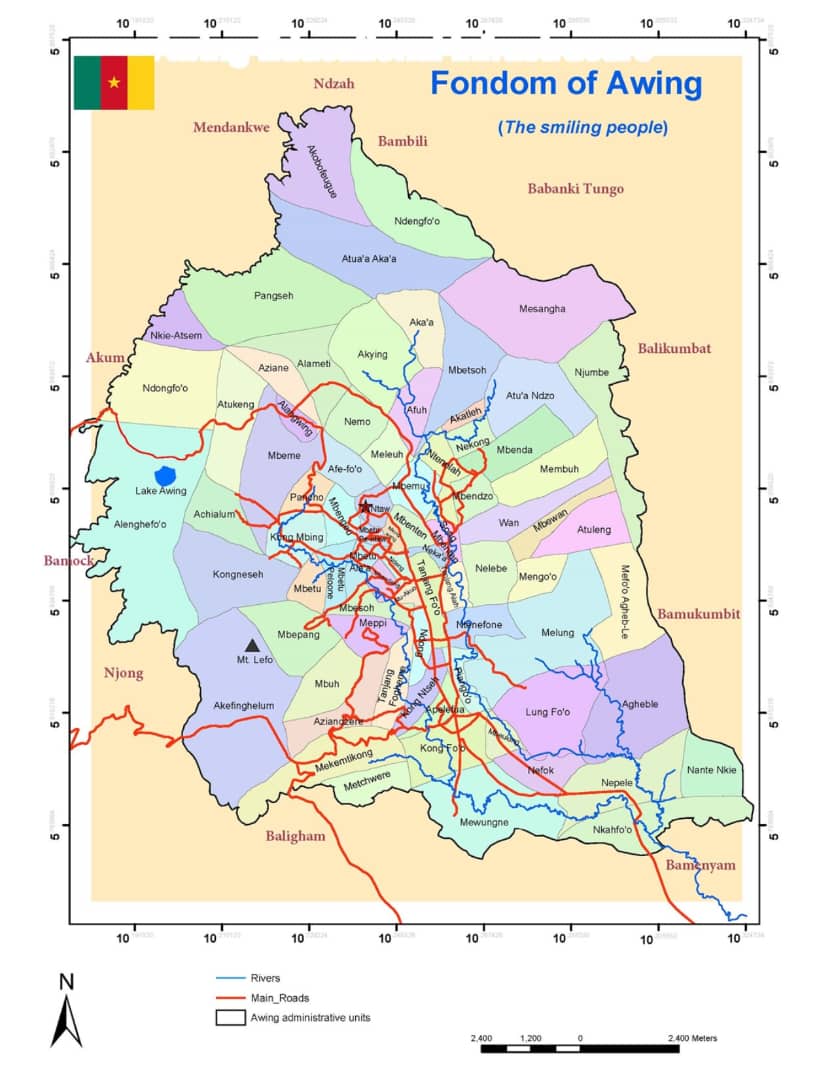
The Awing Fondom is made up of five main regions that are represented in the Central Kwe-fo’o. These include Mbetu, Mbemeh, Mbenten, Mbesoh and Mbenjom. These regions represent the main groupings that come together to form the union that is today called Awing. These five main regions have over the years expanded to several quarters that make up Awing village today. As a matter of fact, the village can boast of at least sixty four main quarters within the Fondom. For the sake of governance, these quarters are decentralised from the palace. Sub chiefs and notables mostly head them.
| ADMINISTRATIVE UNITS OF AWING FONDOM | ||||
| No | Traditional Quarter | Qtr Code | Sub Quarter Name | Sub Chiefs/Quarter Heads |
| 1 | Mbetu | MBU | Mbetu | Tepekene |
| 2 | Mbetu | MBU | Mbetu Peloone | Mbapeh |
| 3 | Mbetu | MBU | Mbetu Pe-ala’a | Mba-Asengwing |
| 4 | Mbetu | MBU | Mbetu Pe-ntaw | Ayafor Temegyie |
| 5 | Mbetu | MBU | Tanjang Ndong | Mbangah |
| 6 | Mbetu | MBU | Tanjang Fogheme | Mbapeche |
| 7 | Mbenten | MBN | Mbenten | Mbatia |
| 8 | Mbenten | MBN | Mengo’o | Nawoseh |
| 9 | Mbenten | MBN | Melung | Atefor |
| 10 | Mbenten | MBN | Melung Mangwe | Francis Pefite |
| 11 | Mbenten | MBN | Aziandzere | Fokoh |
| 12 | Mbenten | MBN | Mekemtikong | Tefokoh |
| 13 | Mbenten | MBN | Metchwere | Maaneh |
| 14 | Mbenten | MBN | Tanjang Fo’o | Fomboh |
| 15 | Mbenten | MBN | Piango’o | Apongnde |
| 16 | Mbenten | MBN | Ntenefone | Ala’apa |
| 17 | Mbenten | MBN | Kong Ntseh | Ndeh Ndenkeh |
| 18 | Mbenten | MBN | Tanjang Ala’a | Kumase |
| 19 | Mbenten | MBN | Tanjang Atu Akuo | Nkwate |
| 20 | Mbenten | MBN | Kong Fo’o | Lucas Laah |
| 21 | Mbenten | MBN | Mewungne | Tanyi Nkang |
| 22 | Mbenten | MBN | Nepele | Tambende |
| 23 | Mbenten | MBN | Nefok | PC Mbako |
| 24 | Mbenten | MBN | Agheb-Le | John Kunezi |
| 25 | Mbenten | MBN | Mefo’o Agheb-Le | Pongme |
| 26 | Mbenten | MBN | Nelebe | Ngocho Temekem |
| 27 | Ntenelah | NTA | Ntenelah | Tangye Mona |
| 28 | Ntenelah | NTA | Alameti | Joseph Sunday |
| 29 | Ntenelah | NTA | Ntaw | Mbatseh |
| 30 | Ntenelah | NTA | Song Mbenten | Christopher Njoke |
| 31 | Ntenelah | NTA | Afuh | Nchumuluh Moko |
| 32 | Ntenelah | NTA | Meleuh | Mbankwene |
| 33 | Ntenelah | NTA | Atsome | Tsop |
| 34 | Ntenelah | NTA | Mbemuh | Solomon Mbamoh |
| 35 | Ntenelah | NTA | Aka’a | Ardo Hamadu Njiaro |
| 36 | Ntenelah | NTA | Nemo | Ndekekang |
| 37 | Ntenelah | NTA | Akying | Nkemande |
| 38 | Ntenelah | NTA | Atu’a Aka’a | Ardo Yaya Dewa |
| 39 | Ntenelah | NTA | Pangseh | Peter Mbamoh |
| 40 | Mbeme | MBE | Mbeme | Ndiame |
| 41 | Mbeme | MBE | Alangwing | Wondoh |
| 42 | Mbeme | MBE | Aziane | Joseph Ayafor |
| 43 | Mbeme | MBE | Mbengeu | Mbangwashi |
| 44 | Mbeme | MBE | Kongmbing | Mbatu |
| 45 | Mbeme | MBE | Achialum | Joseph Takoh |
| 46 | Mbeme | MBE | Pangcho | Tefolack |
| 47 | Mbeme | MBE | Atukeng | Nchasse |
| 48 | Mbeme | MBE | Afe-fo’o | Mofor Tangwah |
| 49 | Mbesoh | MBS | Mbesoh | Mbapegheu |
| 50 | Mbesoh | MBS | Mbuh | Simon Ndzoh |
| 51 | Mbesoh | MBS | Mbepang | Abraham Muluh |
| 52 | Mbesoh | MBS | Mepi | Michael Ndzenewone |
| 53 | Mbesoh | MBS | Akefinghelume | Ardo Ndenkeh |
| 54 | Mbendzo | MBZ | Mbendzo | Mbanjua |
| 55 | Mbendzo | MBZ | Njumbe | Ardo Badiri Buba |
| 56 | Mbendzo | MBZ | Atua Ndzo | Alota |
| 57 | Mbendzo | MBZ | Mbendzo Nekong | Mondikum |
| 58 | Mbendzo | MBZ | Mbenda | Fo’o Netong |
| 59 | Mbendzo | MBZ | Mbewan II | Ndifor Mbankeh |
| 60 | Mbendzo | MBZ | Mbembuh | Mba’ata |
| 61 | Mbendzo | MBZ | Mbewan I | Penanje |
| 62 | Mbendzo | MBZ | Mesangha | Barnabas Mondi |
| 63 | Mbendeng | MBG | Mbendeng Pe-Ndi | Mbamome |
| 64 | Mbendeng | MBG | Mbendeng Pe-Mbah | Ndindeng |